
Astronomers have seen a dramatic change in WOH G64, one of the largest stars known in the universe. This raises the possibility that it is nearing the end of its life and may soon explode in a powerful stellar event.
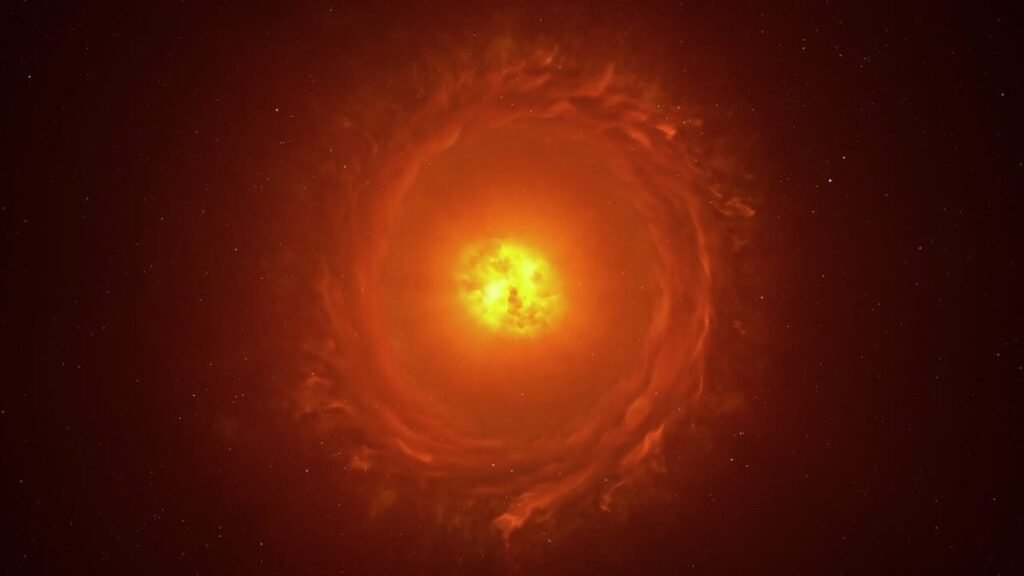
WOH G64 is located in the Large Magellanic Cloud, a satellite galaxy about 160,000 light-years from Earth. This massive star is roughly 1,500 times the size of the Sun and about 28 times more massive. It shines over 280,000 times brighter than the Sun, making it one of the most luminous stars that astronomers have studied in detail.
For many years, WOH G64 was classified as a red supergiant, which is a massive star in the late stages of its life. However, observations over the past ten years have shown something unusual: the star’s color and temperature have started to change. Around 2013 to 2014, it slowly transitioned from a red supergiant to a much rarer yellow hypergiant, showing a quick change in its structure.
This kind of shift is very rare in astronomy. Yellow hypergiants represent a brief and unstable phase in the lives of very large stars. During this time, stars can lose significant amounts of material from their outer layers while their cores contract and heat up. Scientists think these changes may happen just before a star collapses or explodes as a supernova, one of the most intense events in the universe.
Researchers believe that WOH G64’s change may have several causes. One theory is that the star is part of a binary system, interacting with a companion star that might be stripping away its outer layers. Another theory suggests that the star is going through a pre-supernova phase called “superwind,” where extreme internal pressure forces large amounts of gas and dust out into space.
Despite these significant changes, astronomers warn that the star is unlikely to explode in the near future on a human timescale. Even if WOH G64 is approaching its final moments, the supernova could still happen thousands of years from now.
Yet, the star’s rapid transformation is remarkable because stellar evolution usually happens over millions or billions of years. Observing these changes in real time gives scientists a rare chance to study how massive stars evolve and ultimately die.
As astronomers keep tracking WOH G64 with powerful telescopes, this giant star may help answer one of astrophysics’ biggest questions: how the largest stars in the universe meet their end—whether through spectacular explosions or by collapsing directly into black holes.