
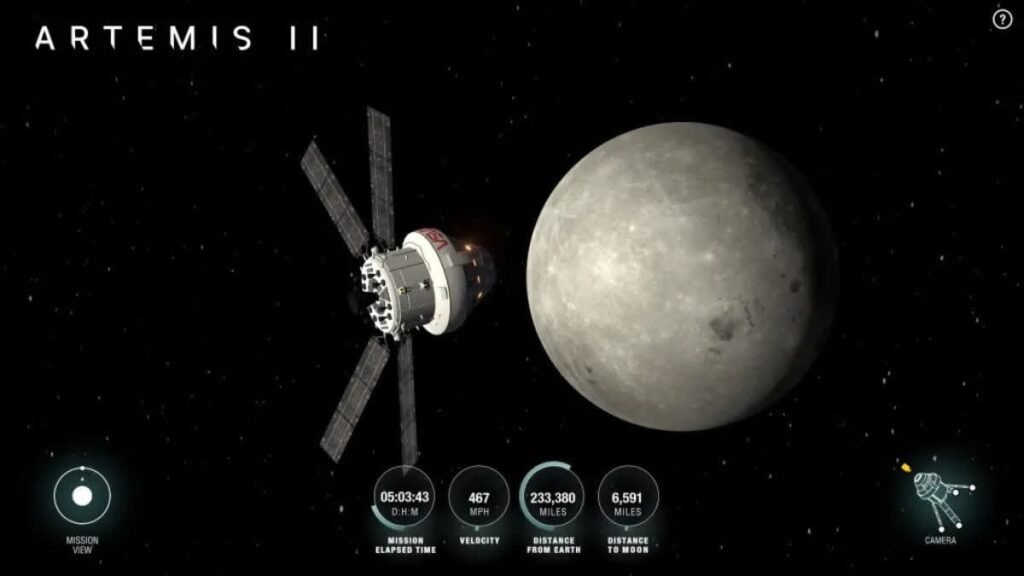
NASA has introduced a new digital tool that lets people around the world follow its upcoming lunar mission in real time. The platform, called the Artemis Real-time Orbit Website (AROW), tracks the spacecraft carrying astronauts during the historic Artemis II mission, providing the public with a detailed view of the journey around the Moon as it unfolds.
The Artemis II mission is a significant step in NASA’s Artemis program, which aims to return humans to the Moon and eventually establish a long-term presence there. It will be the first crewed lunar mission since the Apollo era, sending four astronauts on a roughly 10-day journey around the Moon aboard the Orion spacecraft.
What Is AROW?
AROW is an interactive online platform that allows anyone with internet access to track the position and path of the Orion spacecraft during the Artemis II mission. The system provides real-time information like the spacecraft’s distance from Earth, its distance from the Moon, mission duration, speed, and other key flight data.
NASA explains that the tool collects data from sensors on Orion and sends it to the Mission Control Center at NASA’s Johnson Space Center in Houston. This data is processed and displayed online so users can follow the spacecraft’s journey through deep space.
Real-time updates will start about one minute after launch and will continue throughout the mission until Orion re-enters Earth’s atmosphere at the end of the flight.
How the Public Can Follow the Mission
NASA created AROW to make space exploration more accessible and engaging for the global audience. People can track the mission through several platforms, including:
- NASA’s official website, which will feature the Artemis mission dashboard.
- The NASA mobile app, providing the same tracking tools.
- Live mission coverage and updates via NASA’s digital channels.
The mobile app will also include an augmented-reality tracker, letting users point their phones at the sky to see where Orion is located in relation to their position on Earth.
Data for Scientists and Space Enthusiasts
In addition to public access, AROW will also offer detailed technical data known as state vectors, which show the spacecraft’s exact location and motion. NASA intends to make trajectory data available for download so researchers, developers, artists, and students can create their own visualizations or tracking tools.
This method reflects NASA’s broader plan to share space mission data to promote innovation, education, and global involvement in scientific exploration.
A Key Step Toward the Moon
Artemis II follows the successful uncrewed Artemis I mission in 2022 and marks the first time astronauts will travel aboard the Space Launch System rocket and Orion spacecraft. The mission will test vital systems needed for future lunar landings, including life-support, navigation, and deep-space communications.
By enabling the public to track the spacecraft live through AROW, NASA aims to bring millions of people closer to the mission and inspire the next generation of explorers.
As humanity gets ready to return to the Moon after more than fifty years, tools like AROW change space exploration from something people simply watch on their screens into an experience they can follow moment by moment from their devices.