
Astronomers have found a rare “invisible” galaxy made almost entirely of dark matter. This discovery challenges current models of galaxy formation and provides new insight into the mysterious substance that constitutes most of the universe’s mass.
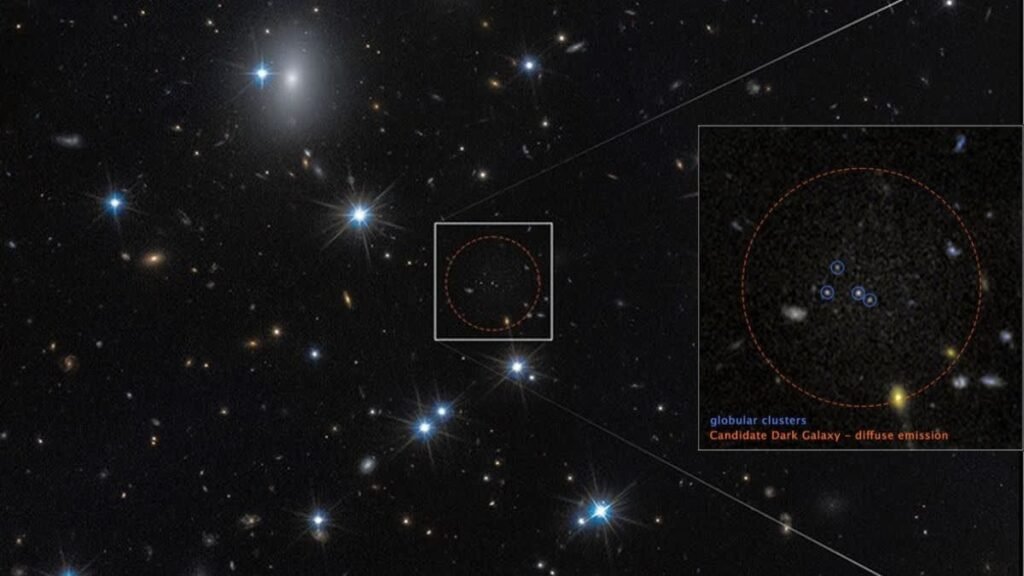
The galaxy, called DF44-DM1, was detected through its gravitational effects instead of visible light. Unlike typical galaxies, which have stars, gas, and dust that emit electromagnetic radiation, DF44-DM1 has very little luminous matter. Scientists inferred its existence by observing how its gravity bends the light of background galaxies, using a method known as gravitational lensing.
Dark matter is a type of matter that does not emit, reflect, or absorb light. It is believed to make up about 85% of the universe’s total mass. However, its characteristics remain one of the biggest mysteries in astrophysics. Most galaxies discovered so far contain a mix of dark matter and regular, visible matter. The newly found galaxy is unique because dark matter almost entirely dominates its mass, with minimal amounts of stars or gas.
The research team, made up of scientists from top observatories and universities, detected DF44-DM1 using data from wide-field sky surveys and follow-up observations from both space and ground-based telescopes. Their analysis shows that nearly all the galaxy’s gravitational mass is due to dark matter, which is unusual since ordinary matter usually contributes significantly to a galaxy’s visible structure.
“This is one of the clearest cases we’ve found where a galaxy is essentially invisible in light but reveals itself through its gravity,” said lead researcher Dr. Maya Estrada from the International Centre for Radio Astronomy Research. “Discoveries like this help us understand how dark matter structures form and evolve in the universe.”
Simulations of cosmological structure formation have long predicted the existence of nearly entirely dark matter galaxies, but evidence from observations has been limited. DF44-DM1 seems to be one of the most extreme examples documented, providing a unique opportunity to study dark matter’s behavior without the influence of stars.
The researchers suggest that the galaxy likely formed in a region where conditions hindered star formation, possibly due to inefficient gas cooling or early energetic feedback that expelled baryonic matter before stars could form. More observations are planned to better understand its properties and investigate similar dark matter-dominated systems.
This discovery contributes to a growing body of evidence that shows dark matter plays a key role in shaping cosmic structure and underscores how gravitational lensing remains a powerful tool for revealing hidden mass in the universe. As astronomers explore deeper, more invisible galaxies may be found, providing clues to one of the most profound puzzles in physics.